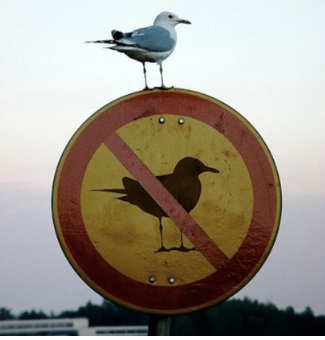
I took this photo in a plane WC a few years ago. If only all warning signs could emote like this.
I took this photo in a plane WC a few years ago. If only all warning signs could emote like this.

Blog posts whoosh past you and get forgotten. So here are one or two from 2010 you might enjoy.
Forget awesome and mind-blowing... we all know that interesting and amusing is as much as we can hope for most of the time.

This is from Punch magazine, 9 May 1962. I've been looking for it for some time but was searching under the wrong name. What astonishes me is that I don't remember any electronic gadgets in the 60s that displayed text. What exactly was he parodying?
Learn With BOOK
by R.J. Heathorn
A new aid to rapid—almost magical– learning has made its appearance. Indications are that if it catches on all the electronic gadgets will be so much junk.
The new device is known as Built-in Orderly Organised Knowledge. The makers generally call it by its initials, BOOK.
Many advantages are claimed over the old-style learning and teaching aids on which most people are brought up nowadays. It has no wires, no electric circuit to break down. No connection is needed to an electricity power point. It is made entirely without mechanical parts to go wrong or need replacement.
Anyone can use BOOK, even children, and it fits comfortably into the hands. It can be conveniently used sitting in an armchair by the fire.
How does this revolutionary, unbelievably easy invention work? Basically BOOK consists only of a large number of paper sheets. These may run to hundreds where BOOK covers a lengthy programme of information. Each sheet bears a number in sequence, so that the sheets cannot be used in the wrong order.
To make it even easier for the user to keep the sheets in the proper order they are held firmly in place by a special locking device called a ‘binding’.
Each sheet of paper presents the user with an information sequence in the form of symbols, which he absorbs optically for automatic registration on the brain. When one sheet has been assimilated a flick of the finger turns it over and further information is found on the other side.
By using both sides of each sheet in this way a great economy is effected, thus reducing both the size and cost of BOOK. No buttons need to be pressed to move from one sheet to another, to open or close BOOK, or to start it working.
BOOK may be taken up at any time and used by merely opening it. Instantly it is ready for use. Nothing has to be connected up or switched on. The user may turn at will to any sheet, going backwards or forwards as he pleases. A sheet is provided near the beginning as a location finder for any required information sequence.
A small accessory, available at trifling extra cost, is the BOOKmark. This enables the user to pick up his programme where he left off on the previous learning session. BOOKmark is versatile and may be used in any BOOK.
The initial cost varies with the size and subject matter. Already a vast range of BOOKs is available, covering every conceivable subject and adjusted to different. levels of aptitude. One BOOK, small enough to be held in the hands, may contain an entire learning schedule.
Once purchased, BOOK requires no further upkeep cost; no batteries or wires are needed, since the motive power, thanks to an ingenious device patented by the makers, is supplied by the brain of the user.
BOOKs may be stored on handy shelves and for ease of reference the programme schedule is normally indicated on the back of the binding.
Altogether the Built-in Orderly Organised Knowledge seems to have great advantages with no drawbacks. We predict a big future for it.
Our doctor's surgery places the receptionists in a space that sticks into the room. There's a perspex screen that they've treated as a notice board, now almost completely covered in notices with random rules and guidance.
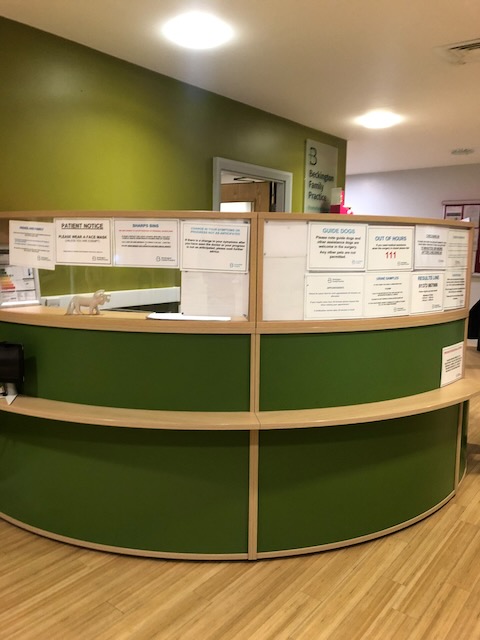
I don't think the notices are there only or even mainly to give information - there's another notice board across the room. They are there to make the receptionists feel more secure.
One of Christopher Alexander's design patterns describes this: 183 Workspace enclosures.
"People cannot work effectively if their workspace is too enclosed or too exposed... You feel more comfortable in a workspace if there is a wall behind you. (If your back is exposed you feel vulnerable–you can never tell if someone is looking at you, or if someone is coming towards you from behind.)"
I wondered if the gap at the back is there because they hadn't enough notices. But I'm pretty sure it is for them to look out through to check who is in the room.

Looked up a What3words reference for our information design summer school, about to start,
It gave me //friends.cuter.behind which is just too Benny Hill to actually give someone (#metoo), so I moved a few metres sideways and got //honey.sizzled.call.
What’s going on?

I've discovered that someone has created a Wikipedia page about me. I've no idea who. It's quite short (obviously) and Wikipedia flags it up as having 'multiple issues'. Well, yes, tell me about it...
I may have mentioned before that I (well, my name) was also listed in the Wikipedia entry 'PG Wodehouse minor characters' where Robert Waller was described as 'a benevolent-looking man, with a pair of mild blue eyes behind his spectacles'. He appears in one of the Psmith books.
I just checked the link and it's gone. But Robert Waller is now listed under a new page called List of PG Wodehouse characters where I am now described as 'an amiable sort, but a secret socialist'. Well, I'll take that too, up to a point.
It's odd to find a Wikipedia page disappear altogether. You can search for deleted pages, though, and find out why someone did this. I've heard that Wikipedia is patrolled by bossy types who like to police other people's efforts. In this case they've justified the deletion by saying '"Minor" denotes that they are inconsequential to the audience of a general encyclopedia'. Literal-minded or what? I hope the entry for Morris Minor isn't next.
Will Stahl-Timmins gave a great talk to the IIID last week (International Institute for Information Design). He is the data graphics designer for the BMJ, a leading medical journal.
Almost as an aside he mentioned the issue of trust: well-finished graphics in a medical context can sometimes be mistaken for marketing by pharma companies.
Integrity can be a problem for infographics, and I've mentioned it before: infographics which round the numbers up or down too much, or which haven't been proof-read against the data, give graphic design a bad name.
Over-simplification is the main objection the plain language movement face. You don't often hear it mentioned in the context of graphic design - perhaps that's because no one actually takes us seriously enough.
.jpeg)
.jpeg)
.jpeg)

On the other hand, Mum...
A lot of English names come from where one of our ancestors lived or what they did for a living (Baker, Smith etc).
This is happening afresh in our smartphone contacts apps when we don't know people's surnames, or think we won't remember why we put them there. How about we start again each generation? It could avoid the problem of whose name to pick when people marry/live together - just make up a new one.


.jpeg)
Actually, multimodality also describes how words combine with pictures.
So this is a multi-modal multi-modal public transport interchange text image combination
Well, yes. I'm a judge of the Plain Language Awards in New Zealand, and we're going through the Public Sector entries at the moment. I've been doing this since 2014, and really enjoy the process which is impressively thorough and open - you can see who the judges are, and what they look for.

There are now several apps you can use to copy text from books – Microsoft Lens, or Adobe Scan, for example. They are pretty good. You take a photo and it scans it with an OCR (Optical Character Recognition) routine to turn it into editable text.
I've noticed that, much like people, these apps struggle with less legible typefaces. So it's possible to use them for informal legibility testing - a kind of app-based strudel test we might say.
Here's some text from a paper I'm writing which I scanned with Microsoft Lens in three typefaces. One is Baskerville which is a typical book typeface, the other is Caslon Italic which most of us would think a bit less legible than Baskerville, and lastly I've included Pixelated, which recalls the earlier for matrix printers of the 1970s and which is on the threshold of legibility.

Lens read Baskerville perfectly, but here's what it managed to read in the Pixelated font:

It's a lot happier with Caslon Italic, although it joined a lot of words together.

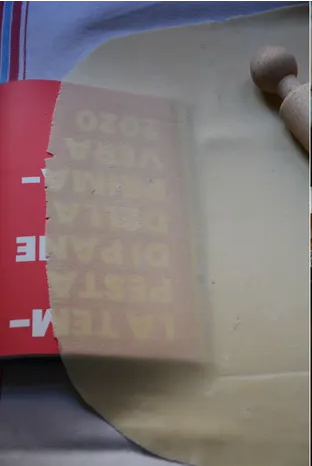
Strudel pastry is said to be thin enough when you can read a newspaper through it. This suggests a legibility test for typefaces – which ones are most legible in these extreme conditions? Can some keen pastry chef set up a test, please?
Rachel Roddy's recipe in the Guardian, from my brief google search, seems to be the only one that actually shows the principle.
Personalised ads in online newspapers sound like a good thing, because you only see stuff you're interested in. Since my seventieth birthday, though, things have taken a depressing turn. Most want me to borrow money against my house using equity release, but today it was...
.jpeg)
...yes, coffins.
On a closer look, though, these are for pets. So the data must have come from an online cat food subscription service that I've mentioned here before, which knows my cat is now of pensionable age.
Our cat is getting old now, and increasingly fussy about its food. So I've tried a couple of the online subscription firms who claim their food is purer and healthier.
The cat seems to like it, but this post isn't about the food. It's about the continuous barrage of kitty puns and whimsy. So, note to cat food companies:
I love coming across old graffiti – it's quite common in churches and cathedrals. Look behind the organ in a typical parish church and you'll find generations of bored kids have left their mark while waiting to start pumping again for the next hymn.
You find yourself muttering about thoughtless vandalism, and then realise that it's dated 1630 or 1842.
What's remarkable to me is that almost all old graffiti has serifs. It seems they are considered as essential a part of the letter as, say the cross bar of the A – not just minor decorative flourishes.
Here's an example from a recent newspaper piece about the discovery of old mine workings:

My last post brings to mind a piece in Punch magazine about an amazing new piece of technology that allowed instant access to information. You could go straight to the part you want, or start at the beginning and work through. It could be easily stored and the information was permanently recorded, etc, etc.
It was called the Body Of Organised Knowledge, or by its acronym BOOK.
Ironically (or perhaps not) I couldn't find reference to this on the internet, so forgive me if I have forgotten the title or the publication... but I don't think I've made it up.
Looking at old encyclopedias* in a bookshelf** it occurred to me that what with the internet an' all, they are a completely redundant genre. So we no longer get those poetic juxtapositions of headwords at the top of pages and on the spine. Amen to Artillery, Art Nouveau to Begin.
.jpeg)
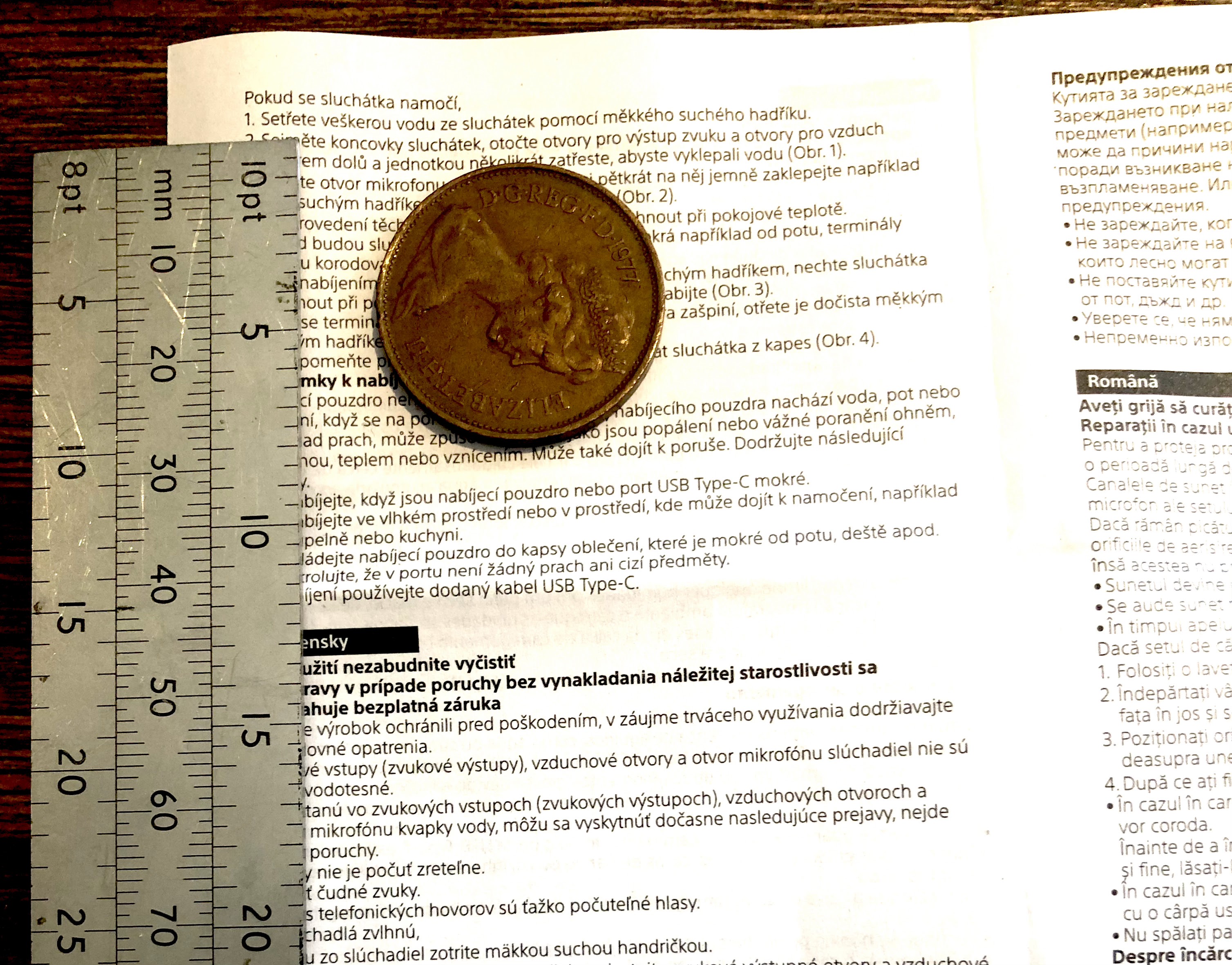
We just bought some headphones - tiny in-ear ones. Hat's off to Sony, who have packed them entirely in recyclable material.

But there's an awful lot to recycle, including four leaflets in 22 languages – both sides are printed in what appears to be 5pt type, possibly smaller.

It's pretty much illegible so why bother? In a recent book chapter* I wrote about consumer contracts in tiny type:
"...can we really say that these business terms have actually been stated in any meaningful way? They might as well have been engraved on a metal plate and fired into space – they would still exist in a theoretical sense, and be no less accessible to consumers."

I do like a pun in a business name. Hairdressers do it best of course (Scissor's Palace, Curl Up and Dye, Hairport, Headmasters, etc).
But this church in King's Heath, Birmingham, is having a go, and I recently saw Triniteas on offer at another one...

It was so sad to hear of the untimely and sudden death of Martin Thomas on 18 January this year. Martin was a lovely guy and one of those rare linguists who studied the relationship of language and layout. He joined our Simplification Centre team at the University of Reading to work on a multimodal corpus.
Martin's doctoral thesis studied a genre in which graphics and text have to work together in a confined space for a very particular set of purposes: multilingual toothpaste packaging (Chinese/English). He built up quite a collection.
Occasionally I run plain language training and it's good to teach with examples. Often I have to make them up because I can't find a real life example, so it's nice when a journalist does the job for me.
Thanks, Birmingham Mail:

I recently saw this bridge in Lisburn, Northern Ireland - you have to ask: how big does this sign have to be? I can imagine each time it's hit, they make a new sign, each one bigger than the last.
The problem is that all communication requires a contribution by the reader. On your day off, driving your car, this sign does not address you. But if you forget that you're driving a double decker bus, it doesn't matter how big the sign is. It's all about relevance.

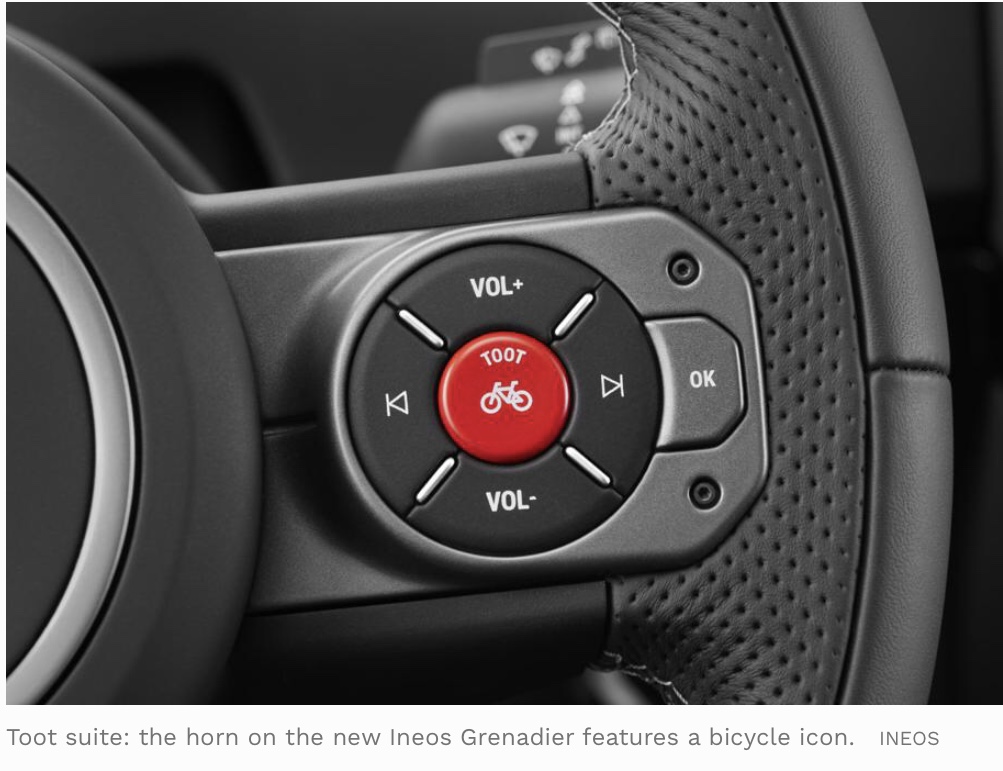
In a taxi in Istanbul a year or two back I was impressed by the driver’s light (and more or less constant) touch on the horn. He was able to produce a light toot as a gentle prod, or a savage blast when necessary.
I’ve long wanted a set of horn buttons - a gentle toot to say hi to a friend I’ve spotted, or ‘I’m outside your house’. A klaxon to say ‘Oi, you just cut me up’, a loud but cheery one to say ‘watch out I’m coming round the corner’.
Now Ineos have done exactly this on their new off-roader, the Grenadier. Brilliant.
But I still want some drum pads on the steering wheel to play along with the radio.
Ken Garland has died at the age of 92. I had this copy of his Graphics Handbook while still at school and was delighted to find him as a tutor when I went to study typography at Reading. According to Jonathan Bell's obituary just published in Wallpaper, this would have been his first year there, in 1971. I think it was Ken's concern for communication, not ornament, that sent me in the direction of information design, and I took his 1964 First Things First manifesto seriously: "We hope that our society will tire of gimmick merchants, status salesmen and hidden persuaders, and that the prior call on our skills will be for worthwhile purposes."
Flicking through his collection of articles and lecture notes, A word in your eye, I recall how good a writer he was. There are subtle and appreciative obituaries there of Henry Beck, Alfred Wainwright, Anthony Froshaug and Ernest Hoch, beautifully observed, and I hope someone more capable than me will write one as good for him. Ken was hugely supportive during some difficult times following the launch of Information Design Journal, and I feel very lucky to have known him and to have been taught by him, and that my career took its direction from his ideals.
This sign outside a church in Bath shows good design thinking.
It's on a busy road but drivers might glance across.
We know it's a church. We know they meet on Sundays. The only thing that's worth saying legibly enough to be read at a glance is '10.30am'. And the sheer size of it gives a strong affordance of 'you're invited'.

After an awful customer service experience, you want to vent by writing it up on Trustpilot. But no one wants to read your fifty line rant.
So how about a simple scoring system, so you can say, for example:
"Cooperative Bank (to pick a brand at random... not really)120 minutes time on phone10 days to resolve my problem225 Marks of Shame."
This way people would get a measure of the severity of distress caused but don’t have to relive it. The Marks of Shame would accumulate rather like the way they mark Olympic ice dancing, with each move given points for technical merit and artistic impression. For example,
I've just discovered the American poet Wendell Berry, who writes beautiful reflections on life, the countryside, the seasons, belonging.
Throwing away the mail
An oxymoron is when two contradictory terms are used together, usually for rhetorical effect – 'deafening silence', for example.
How about this instruction from Made.com about how to return a chair that just collapsed after 2 years:
We’ve made our returns as easy as possible. All you'll need to do is:1)Re-package your item (they’ll need to be in the original packaging or a suitable alternative)...

On a church door in Italy.
I know that's supposed to be a tourist guide in the top icon, but having just emerged from the Uffizi I'd seen a lot of images with a larger central figure with raised hand and a halo...
Incidentally, that's a man's hat in the icon - women are fine with hats, and in fact St Paul insisted on them.
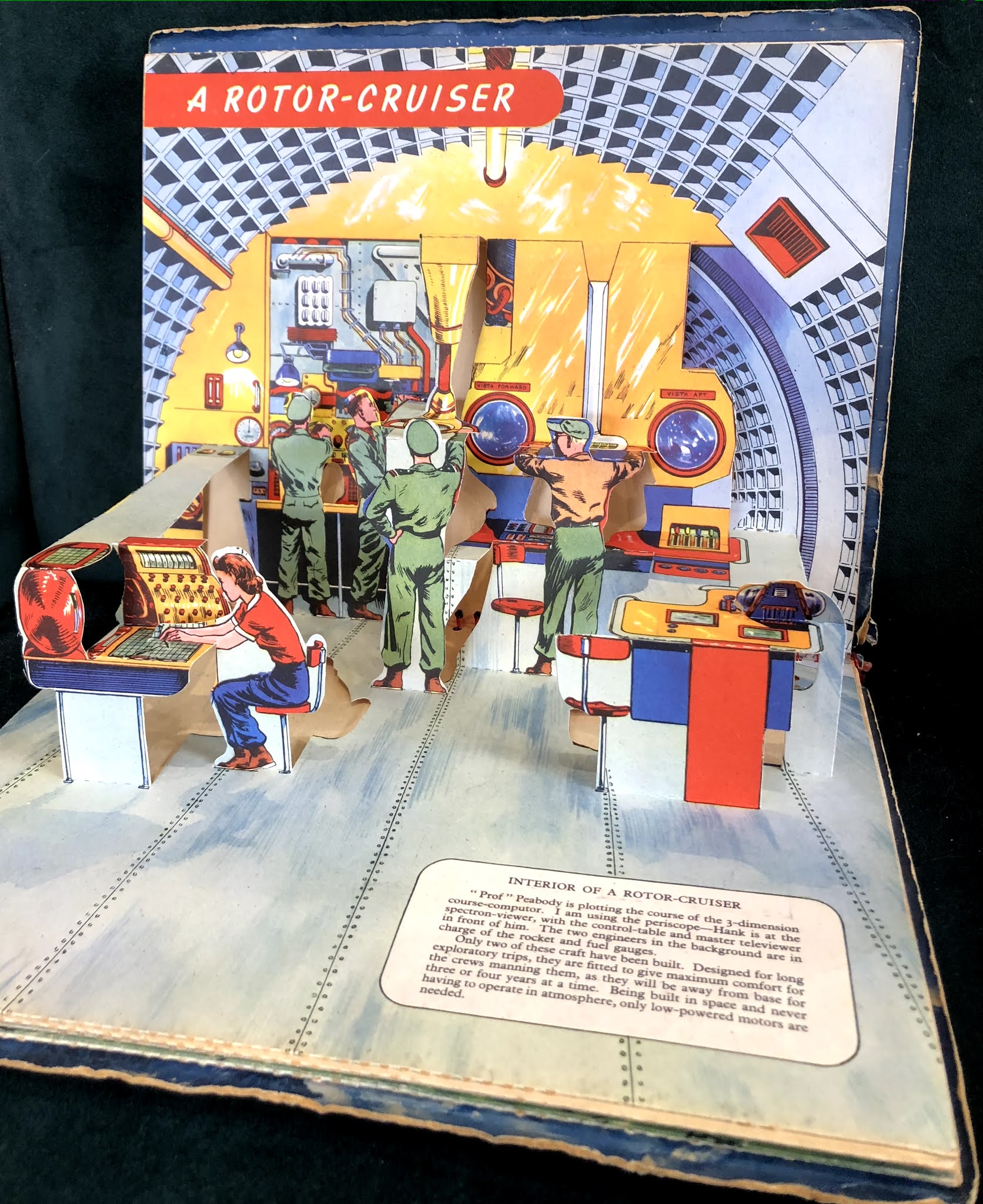
The comic book character Dan Dare is 70 this year. If you don't know of him, ask a sixty-something year old Brit who read Eagle comic as a child.
Here's my Dan Dare pop-up book:

'...Einstein may have crafted this aphorism, but there is no direct evidence in his writings. He did express a similar idea in a lecture but not concisely. [Composer] Roger Sessions was a key figure in the propagation of the saying. In fact, he may have crafted it when he attempted to paraphrase an idea imparted by Einstein.'

"An interesting item and the story is indeed Bestall's and the date noted above it is in the hand of Ian Robertson who was the Rupert Editor at the time this was reprinted in the Express.The story is Rupert and Raggety and the reprinted story used 27 of the original 40 panels.It would appear that the Express have used a b/w copy of Bestall's original artwork and someone has coloured it for reproduction in the newspaper. Who the colourist is I do not know but they were using Gina Hart as a colourist at the time so it could be she.How this escaped from their archives I cannot speculate but it is an interesting and unique item."
Simplification often involves pruning information that has grown too long. It's often grown too long because of ill discipline in the writing process – we forget what and why we're trying to communicate, and each thought sparks off another.
The wonderful Eric Blore shows how it's done in this clip from the Fred Astaire film Shall We Dance?
When banks warn you about fraudulent emails, they always advise you to look out for spelling mistakes. But why is it that the fraudsters can't spell or recruit a reasonably literate criminal to proofread for them. I think there's an opportunity here.
Here's one I got today:

Yep, definitely dodgy I'd say.

Visiting the Uffizi in Florence, it was refreshing to see graphic prohibitions that don't try to be traffic signs. I don't think I've seen this way of showing a negative on a public sign before (rather than a smartphone app).



.jpeg)