Showing posts with label Small print. Show all posts

Wednesday, June 08, 2022

Illegible in 22 languages

We just bought some headphones - tiny in-ear ones. Hat's off to Sony, who have packed them entirely in recyclable material. 

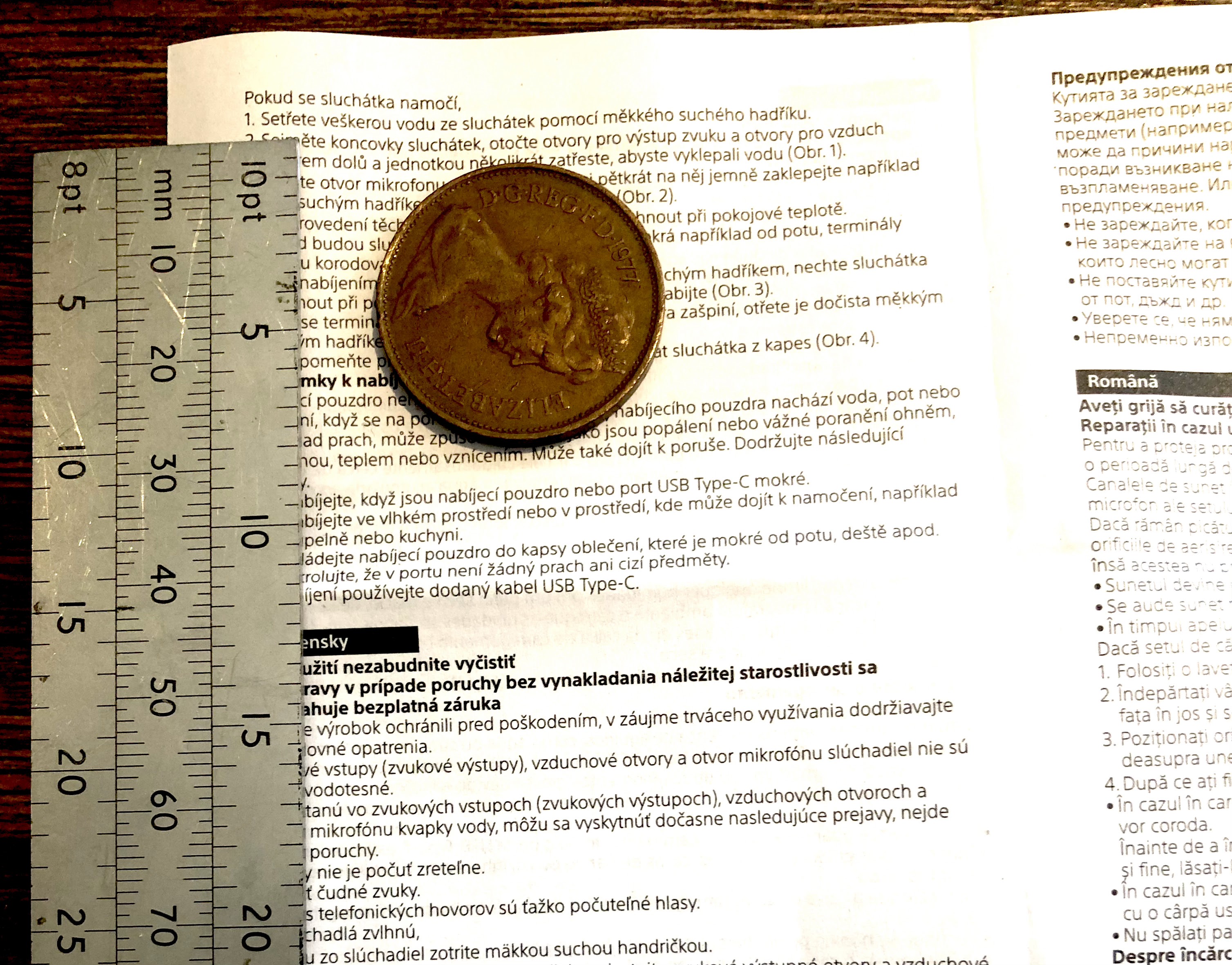
But there's an awful lot to recycle, including four leaflets in 22 languages – both sides are printed in what appears to be 5pt type, possibly smaller.

It's pretty much illegible so why bother? In a recent book chapter* I wrote about consumer contracts in tiny type:

"...can we really say that these business terms have actually been stated in any meaningful way? They might as well have been engraved on a metal plate and fired into space – they would still exist in a theoretical sense, and be no less accessible to consumers."

To give you a sense of scale, in the picture below there's a 2p coin and a type scale (younger designers – you won't know what this is, but we used it to measure typesizes before computers).


*Robert Waller (2022) ‘Designing contracts for human readers’ in Marcelo Corrales, Helena Haapio and Mark Fenwick (eds), Research Handbook on Contract Design, Edward Elgar Publishing.


Tuesday, April 26, 2016

Read the rules ("rules")


McDonalds is running a Monopoly-themed promotion. I hope you all understand the rules ("rules").


Wednesday, November 18, 2015

Small print nightmare from 1972

I've been blogging on the Simplification Centre website about the new 2015 Consumer Rights Act, which is supposed to banish the small print (we'll see). I came across this nice example of coverage of this issue from The Guardian, 30 October 1972.

“Intrepid travellers on the cross Channel routes have come up against amazing exclusion clauses in the small print on the tickets that rarely get read. Translating the legalese into practical terms, one such traveller concludes that: ‘The combination of conditions 3, 5, 6, 9 and 11c allow Normandy Ferries to have an incompetent employee stow dangerous cargo insecurely alongside my car and to divert the vessel from Le Havre to, say, Bilbao. If, as a result, the incompetent captain is unable to cope with the rigours of the Bay of Biscay so that the pitching of the unseaworthy ship causes the dangerous cargo to come adrift and if, consequently, it blows up hurling my car into the air and sinks a passing fishing boat with all hands, then not only do I have no claim against Normandy Ferries but I also must indemnify them against all claims made against them”.

I found this quoted in an EU document: "Report on the practical implementation of Directive 93/13/EEC in the United Kingdom and the Republic of Ireland", 1999, by Brian Collins.


Thursday, July 14, 2011

Small print the movie?

Thanks to Beth Shepherd who sent this and told me about the wonderful Every Day Posters Every Day site, where it comes from.

I have read and understood...

At the Simplification Centre we're looking at fresh ways to approach the small print - the contracts we sign when we install software, get a mobile phone, borrow money. I was speculating that if we sincerely want people to understand these things, wouldn't we apply best practice from textbooks - a genre where people genuinely have to and want to understand the content. In a textbook we expect summaries, explanations, definitions, diagrams... and even aims and objectives, and self-test questions. We expect legible type, plenty of white space, and pictures to relieve the tedium. A photo and short biog of the author on the back, too, of course.

Jenny then suggested going one further: if we are really sincere about communicating contract conditions, people should sit an exam before they can sign.

Of course the opposite could equally be true. Instead of sitting an exam at the end of their university course, students could simply sign a declaration: 'I have read and understood this course'. Thank you ma'am: here's your car keys/loan/degree certificate.

Wednesday, June 29, 2011

Unclear - just a typo away from oblivion

Discussing ways to simplify consumer contracts recently, the marketing director of a large firm remarked that his firm's contract contained various clauses that they never actually enforce because it would bad for their reputation. He thought they might as well just leave them out. When translated into plain English some contract terms might just seem too toxic to leave in.

It occurs to me that the process of simplification is also a kind of defusing or disarming. The Campaign for Unclear Disarmament, anyone? No, I thought not. That pun will go no further than this blog.

Tuesday, March 15, 2011

Yellow Pages shrinks further

The once mighty Yellow Pages is shrinking in the face of internet competition, and now they've literally shrunk the book itself. Ours arrived today and the print is so small I thought it was a contract needing my signature.

Odd thing is that the paper edition is really only useful for people without a PC, many of whom are elderly... who happen to be just that part of the population who struggle with tiny type.

One good thing is that most of the opticians seem to be on to this and have large print ads.

Sunday, February 06, 2011

Plain English - does it translate?

The European Union is making a welcome effort to introduce plain language principles, and last year produced a plain language guide, How to write clearly. A recent newsletter 'Languages and translation' refers to the rise of not just English but 'bad English as the Commission’s lingua franca'. It asked a number of translators to reflect on how they adapted the guide to various different EU languages.

We know that the rules of plain English don't directly translate into other languages – for example, English has many expressions for which there are latin and anglo-saxon alternatives - the latter are seen as plainer ('get' instead of 'receive'), but the equivalent vocabulary choice is not an issue in other languages. And we can use noun clusters in a way that just doesn't work in French, so our sentences can often be shorter.

But I found myself wondering if some of the translators' comments were actually about real grammatical differences between languages, or whether they didn't hint at an earlier stage of plain language evolution in those cultures.

It was very noticeable that the recommendation, common in plain English, to use the active voice, met with resistance:

"A chapter on the use of the passive voice was modified as the use of the passive voice in Latvian is not always a bad choice."
"Hint 8 (‘Prefer active verbs to passive’) could well be valid for conversational Lithuanian, but not for legal texts. In fact, the passive often takes precedence over the active here, especially when there is an inanimate subject."
"The over-use of the passive voice may be more of a problem in English than in Portuguese, as the latter favours the impersonal active."
But Plain English also involves the introduction of a more conversational style into legal texts, and met with similar objections many years ago. The point about active sentences is that they specify the doer, and so someone has to take responsibility for an action. Passive sentences avoid commitment. I wonder if that's not the same in Latvian, Lithuanian and Portuguese.

And again:
"The most difficult bit to get around had to do with addressing the reader directly. The English guide suggested using the personal pronoun ‘you’ more often in documents — something which is certainly to be avoided in formal Portuguese. Direct address is acceptable in advertising or in direct information to the public, but in other areas it may be wiser to use impersonal constructions."
Plain English, too, is nearer to an advertising style than was once acceptable. Isn't plain Portuguese also bound to appear less formal than is traditional in official documents?

I'd love to be corrected by someone who knows what they're talking about.

Friday, October 08, 2010

Plain Words in plain English

Sir Ernest Gowers is rightly acclaimed for his handbook on clear English, The Complete Plain Words. Published in 1948 it has never gone out of print.

It was aimed at civil servants communicating with the public, and in the first edition he writes "The purpose of this book is to help officials in their use of written English. To some of them this may seem a work of supererogation, calculated only to place an unnecessary new burden on a body of people already overburdened."

That's right - supererogation. I had to look it up too (it means 'spending over and above, beyond the call of duty'). And I had take a couple of run-ups before being able to say it out loud (think super + erogation).

A civil servant in 1948 would no doubt know this word, and therefore Gowers's sense of audience was impeccable. But these days we would tend to write about plain English in plainer English.

So I've had a go at translating a key section of Plain Words into plain English:

The original reads:
"A new technique is being developed for those pamphlets and leaflets that are necessary to explain the law to the man in the street in such matters as P.A.Y.E. and National Insurance. Its guiding principles are to use the simplest language and avoid technical terms, to employ the second person freely, not to try to give all the details of the law relevant to the subject, but to be content with stating the essentials, to explain, if these are stated in the writer's words and not the words of the Act, that they are an approximation only, to tell the reader where he can find fuller information and further advice, and always to make sure that he knows what are his rights of appeal."
Proof, perhaps, that a 92 word sentence can be reasonably easy to read if it is simply a list separated by commas. Here's my version:
"How to explain things like P.A.Y.E. and National Insurance :
  • Use simple language and avoid technical terms
  • Use ‘you’ as much as you can
  • Don’t try to give all the details, but just give the basics
  • Say where people can find fuller information and further advice
  • Always make sure people know their rights of appeal."
We haven't really improved on that advice in 60 years. To try would be supererogation, 'nuff said.

Monday, May 03, 2010

Small print and your immortal soul

You may have read about the computer game company who inserted a new clause in their small print as an April Fools' Day jape. Around 7,500 customers apparently assented to terms and conditions that included the transfer of rights to their immortal soul to Gamestation.

On the basis that 12% of customers ticked an opt-out clause, Gamestation estimate that 88% of people fail read the small print before making online purchases. I'm surprised as many as 12% read them - I've asked this question at a number of conferences where I've spoken, and I reckon 2 out of about 400 people have put up their hand and admitted to reading the small print.

I found a nice comment about this on Mumsnet (in case you're wondering, no, I'm not a Mum - I googled it).

According to commenter GerbilMeasles, these are known as Friday Sandwich Clauses, and are sometimes inserted by playful solicitors to check if the other side is actually reading the contract they are supposed to be negotiating: 'They normally read something like "On completion and for a period of fifteen years from completion, the Vendor's solicitors shall on request from the Purchaser's solicitors provide on each Friday that is a Business Day a selection of sandwiches, pastries and other snacks as specified by the Purchaser's solicitors."'

Apparently a surprising number of these make it through to the final draft.

Friday, January 01, 2010

If I may be so bold


This is a nice demonstration of encroaching-boldness syndrome from Barclay's banking website. Everything is very important, except for 'This is the', 'of', 'for the' and 'They are presented in'.